Datadog monitors systems. Multiplayer fixes bugs.
Multiplayer gives your coding agents (and developers) the unsampled, full-stack runtime data they need to fix application bugs automatically.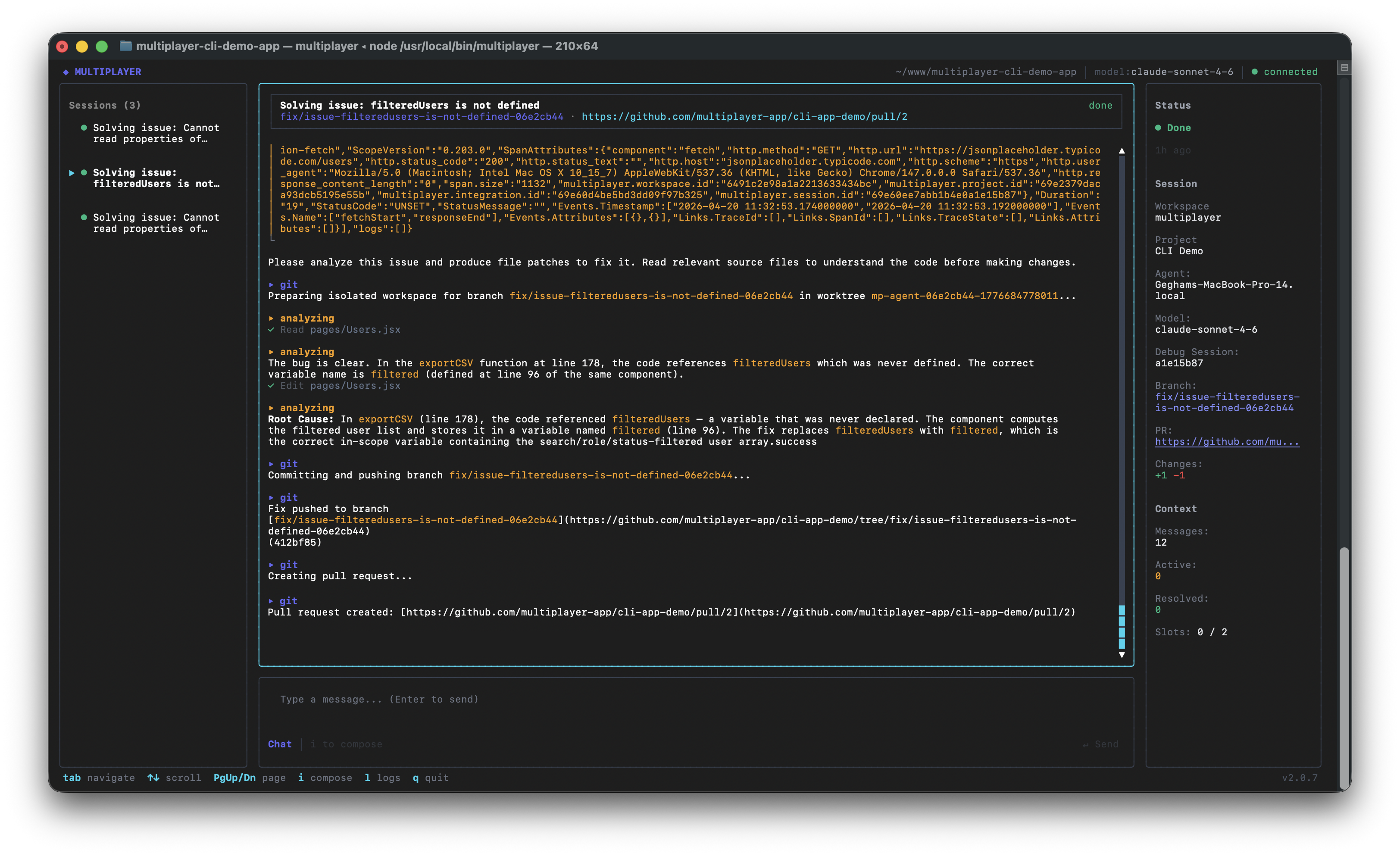

How is Multiplayer different?
Purpose-built for debugging, not monitoring
Multiplayer is built from the ground up to close the loop from issue identified to PR created and bug fixed.
- Datadog is a broad monitoring platform built for Ops teams tracking system health and trends across infrastructure. When a bug needs fixing, developers and coding agents get an alert (from a noisy dashboard), then they're on their own: grepping through logs, correlating data across tools, and manually assembling the context needed to write a fix. Datadog tells you something broke. It doesn’t fix it.
- Multiplayer is designed to fix application bugs automatically.
It runs locally next to your preferred coding agent and manages the whole process from bug identified to bug fixed: data gathering, intelligent triage and issue deduplication, coding agent prompting, PR creation and user notification. We group, score, and consolidate issues to generate a targeted list of high-quality, merge-ready Pull Requests (PRs).
Session-based, full stack runtime data
Multiplayer’s session-based, full-stack approach and local caching ensures coding agents and developers receive precisely the runtime data needed to debug, without the noise and cost of Datadog data collection.
- Datadog samples and misses critical data, generating huge volumes of raw telemetry (and high bills). To achieve Multiplayer’s level of unsampled, correlated, full-stack visibility, you need manual instrumentation, custom logging, third-party integrations, and higher-tier plans. Without that, coding agents and MCP servers inherit every limitation of your Datadog data: sampled traces and logs, missing correlation, context that stops at system boundaries. The result is a coding agent working from incomplete data, generating fixes you can't trust.
- Multiplayer automatically captures unsampled, full-stack session data, correlating frontend user actions directly to backend traces, logs, and information Datadog misses such as request/response content and headers from all components in your system. We cache sessions locally and only send data when we identify a new issue. We automate bug fixing by feeding coding agents the exact runtime data they need, without the manual middle steps.
Runs anywhere, works with any agent
Multiplayer gives developers complete control over what gets debugged, where, and how. No vendor lock-in, no complex pricing tiers.
- Datadog creates vendor lock-in through its proprietary agent (Bits AI), instrumentation layer, and SaaS-only backend. It routes everything through its cloud infrastructure, and charges per host regardless of how much data you actually need to fix a given bug. Even with OpenTelemetry instrumentation and MCP integration, developers encounter the same underlying problem: data built for monitoring dashboards, not for coding agents trying to fix bugs.
- Multiplayer runs locally, next to your favorite coding agent. Run it in any environment: prod, dev, QA, test. Vendor-agnostic by design, it works with Claude Code, Codex, Copilot, Cursor, and whatever ships next. Built on OpenTelemetry, compatible with all backend observability platforms. It’s available as open source but if you don’t want the headache of self-hosting, the hosted version is priced to reflect the leaner data model, while your code never leaves your machine.
Why use Multiplayer?

Better data for AI agents (and humans)
Full-stack, auto-correlated, unsampled. Everything you need from frontend screens to backend traces and logs. We also include things your observability tools miss like request/response content and headers from all components in your system.
Plug & Play with your favorite coding agent
Claude Code, Codex, Copilot, … Route issues directly to any and all coding agents you already use and love. No tool switching or ramping up on a proprietary coding agent. Connect our debugging agent to prod and auto-fix bugs while your system is running.
Local first, more secure
Run Multiplayer right next to your coding agent. We cache sessions locally and send data only when we identify a new issue. Complete control over what you debug. Your code is safe: unlike other debugging agents we don’t need access to it.
Intelligent issue creation and deduplication
No PR slop or review fatigue. We gather only the data you need and just enough of it. Issues are deduplicated so the same bug is only tracked once, no matter how many times it was reported. You never have to review or fix the same issue twice.Your coding agent is only as good as
the data it uses. Give it what it needs.
Self-host Multiplayer for free straight from the repo.
Open a GitHub issue for any questions or issues
Check out our in-depth technical documentation.
Best practices on system design, debugging, and observability.