Developing API integrations
with confidence
Develop faster, keeping your integration logic connected, testable, and grounded in real system behavior.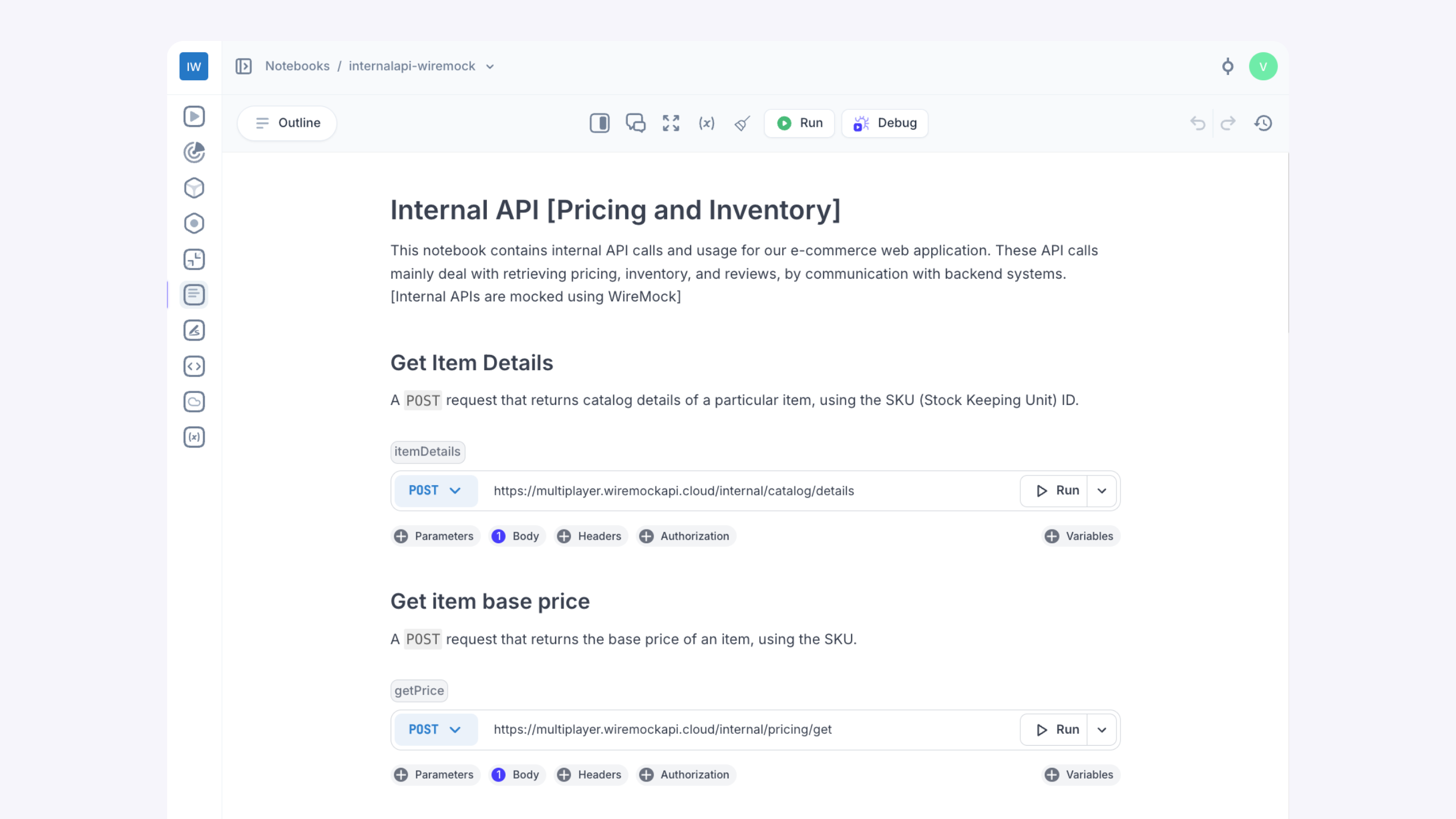

“I’m no longer reverse-engineering APIs during dev. We run and validate API flows right inside Notebooks”

Build API integrations that don’t break under pressure.

Problem
- Slow development cycles caused by inaccurate API docs, missing design rationale, or unclear integration scope
- Misaligned development across teams due to lack of a finalized API contract or shared assumptions
- Limited or time-consuming visibility into API flows
- Coupling issues and fragile deployments due to unclear upstream/downstream dependencies
- Struggles to mock environments while testing niche or specific endpoints
Solution
- Faster development with auto-generated, always-accurate API docs and built-in design context
- Single source of truth where integration scope, edge cases, and API behavior are documented and validated collaboratively
- Live visibility into API flows across components and systems
- Real-time dependency mapping
- Rich sandbox environment to test complex flows and uncommon edge cases
Simulate, test, and ship integrations that just work
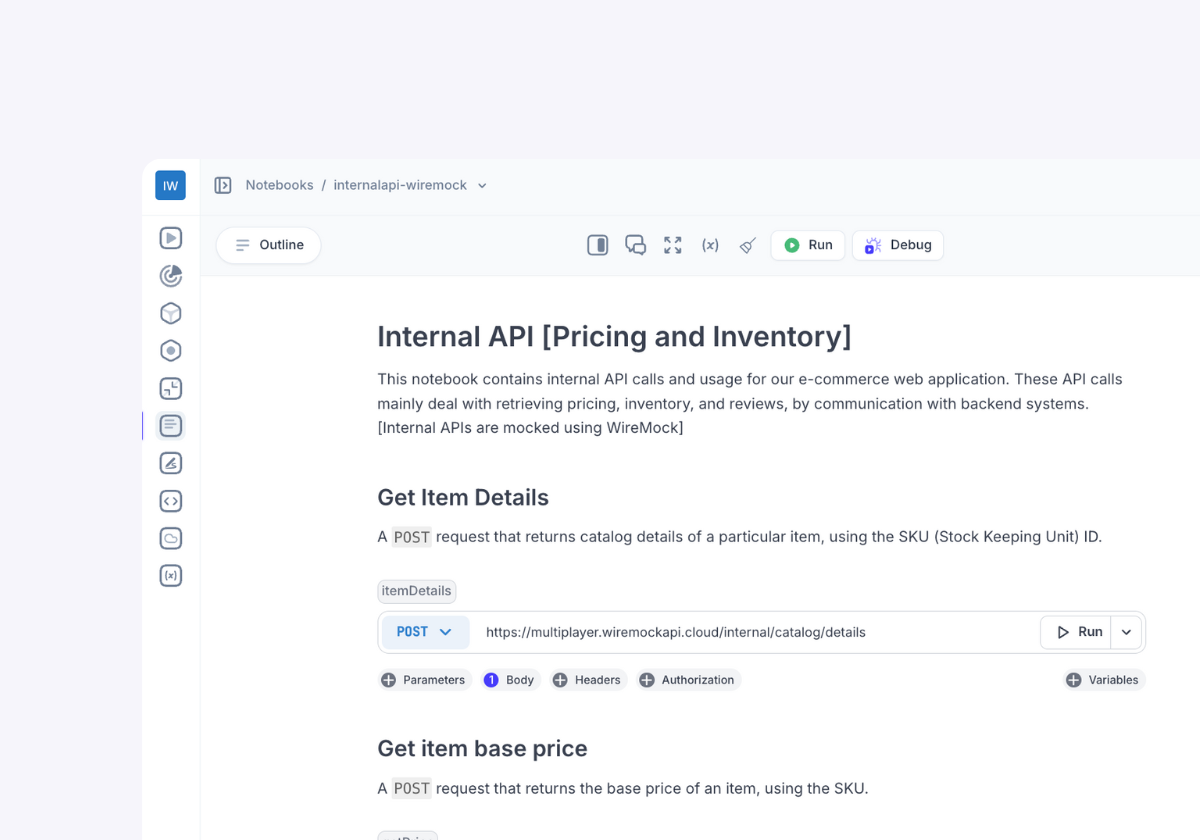
Real internal integrations involve dependent calls—like fetching a user ID, then calling another service to assign roles.
Sequential executions let developers simulate full request chains (e.g. GET /users → POST /roles), ensuring intermediate data like IDs or tokens are handled correctly across steps. It's an easy way to validate how services interact without writing glue code upfront.
Why choose Multiplayer Notebooks for API development?

Faster development
Cut guesswork with auto-generated, live, up-to-date API documentation straight from real system behavior.
Reduced context-switching
Run API calls, prototype logic, and verify flows directly inside Multiplayer, replacing half a dozen dev tools and tabs.
Visibility into API behavior and flows
Fully understand each single API behavior and get a clear picture of how data moves through the system. You can visualize and simulate entire integration flows.
Test edge cases and fallback logic early
Simulate retries, error states, auth failures, and payload variations before anything hits production.
Tight cross-team feedback loops
Bring backend, frontend, platform, and product into one shared design surface, eliminating misalignment and reducing costly handoffs or rework.
Live dependency mapping
Avoid accidental coupling and missed downstream effects. Multiplayer automatically maps upstream/downstream services so you can develop with confidence.Start today for free
pairs with
Debugging agent for developers
The Multiplayer debugging agent connects your favorite coding agent to prod to fix application bugs automatically. It manages the whole process from bug identified to bug fixed: data gathering, intelligent triage and issue deduplication, coding agent prompting, PR creation and user notification.pairs with
Notebooks
Combine executable code blocks, API calls, specs, and unsampled, full-stack session data to validate flows, generate test scripts, or debug, test, and document API integrations.See the full picture of how APIs behave and interact
Traditional static docs often fall short in conveying the dynamic nature of APIs or demonstrating real-world usage.| Feature | API Tools | Multiplayer |
|---|---|---|
| Test API calls | ||
| Collaborate with external teams (Devs, Partners, QA, CS, etc.) | ||
| Integrate within existing CI/CD pipelines | ||
| Write and run inline code within API workflows | ||
| Chain API and code blocks together | ||
| Test multi-step integrations | ||
| Debugging agent to automatically fix bugs next to your coding agent | ||
| Embed explanations, ADRs, design notes | ||
| Embed graphs and tables |
Develop API integrations with speed and clarity
Use Multiplayer, build better API integrationsSelf-host Multiplayer for free straight from the repo.
Open a GitHub issue for any questions or issues
Check out our in-depth technical documentation.
Best practices on system design, debugging, and observability.