The shift from single- to multi-player in software development
The rise of multi-player, real-time collaborative tech has swept across many industries. We look at when, why, and how this happened and what's next for dev tools.


The shift from single-player to multiplayer in software can also be described as the rise of real-time collaborative tech.
This wave has swept across many industries, especially those that struggle with high fragmentation and multiple stakeholders who own siloed parts of the value-creation process. It's not just the gaming, design, and "productivity" (note-taking, screen-sharing, meeting, project management, etc.) industries that have been revolutionized by adopting multi-player technology, though. Many SaaS businesses, even companies that haven't traditionally thought of themselves as collaboration-first, are now deciding to adopt multiplayer features in their applications.
Today, we all agree that collaboration in the workplace is a must. This is particularly evident in software development, which is an intrinsically collaborative process involving teams of developers, QAs, support engineers, and PMs working in their own remote environments, constantly needing to share context and align on what's broken and what needs to be built.
So, how did we get to the point where internet-based, collaborative development tools are a must?
Causes of the shift from single- to multi-player
Here are three macro trends to keep in mind, which have shaped the tech industry and made multi-player functionality necessary. It's not a coincidence that collaboration software was the only software segment that posted positive (6%) growth during the onset of COVID-19 (BusinessWire, 2021) and the market size is expected to expand at a compound annual growth rate of 9.5% from 2022 to 2030.
Shift towards distributed systems. Today, the cloud underpins most new technological disruptions and the implementation of distributed cloud models is ever-expanding. In fact, 67% of enterprise infrastructure is now cloud-based while McKinsey reported that the average enterprise had achieved less than 20% percent cloud adoption in 2018. In a way, we're all distributed system engineers now.
Shift from in-person collaboration to online collaboration. Even with RTO (return to office) trends, collaboration is still more and more web-based. Think of how many tools for meetings, document creation/editing, design, customer support, etc. you use daily. Remote collaboration (in one form or another) is here to stay and that globally distributed engineering teams are very common, if not the norm.
Shift to browser-based applications. Think of all the software startups that raised significant venture capital funding in the past few years (e.g. Lucid, Figma, Sourcegraph, Replit, etc.) and of top performing apps like Figma, Miro, Hubspot, Asana, Github, etc.. What's important to notice is that most (if not all) of the collaboration and productivity tools are architected with multiplayer functionality at their core. That's because modern users intuitively understand that Internet native software should embody values like collaboration, transparency, and access.
Welcome Player Two: benefits for developer tools
With the increase in remote engineering teams, the beauty of simply opening a shared view and seeing the same information (whether it's a bug investigation, a feature plan, or a system architecture diagram) becomes significant. But let's dive a little deeper:
Better cross-team communication (= faster problem resolution)
When a bug surfaces or a feature needs scoping, the worst-case scenario is context trapped in silos: support has the user's description, engineering has the logs, product has the requirements, and nobody has the complete picture.
Multi-player tools that let teams collaborate on the same technical evidence eliminate the overhead of translation and misunderstanding. Everyone sees the same thing, in real-time, with full context.
Shorter debugging and development cycles (= quicker time to market)
If your goal is to deliver better software faster, you need to eliminate the friction between "something's broken" and "here's the fix". Traditional debugging workflows where support files a ticket, engineering tries to reproduce the issue, product clarifies requirements, and everyone exchanges screenshots and log snippets, create massive delays.
Multi-player collaboration on complete technical context means teams can go from problem to solution without the back-and-forth. The same annotated session that documents a bug becomes the specification for fixing it and the test case for verifying it.
Increased product quality and customer satisfaction
When support can show engineering exactly what customers experienced bugs get fixed faster and more accurately. When engineering can annotate session recordings to show product and design exactly how features behave (frontend interactions correlated with backend logic) features ship with fewer misunderstandings.
The ability to collaborate on shared technical evidence, rather than fragmented descriptions, means fewer regressions, fewer miscommunications, and happier users.
Multi-player for software debugging?
While there are now exceptional apps to help developers visualize and work collaboratively on their code or at the API level, there hasn't been a lot of improvement in how cross-functional teams can work together to debug and resolve technical issues.
The problem isn't lack of tools. It's that the tools create silos:
- Frontend teams use session replay to see user interactions
- Backend teams use APM to monitor traces and performance
- Support teams file tickets with text descriptions and screenshots
- Product teams maintain separate documentation and requirements
- Everyone has fragments of the truth, but nobody has the complete story
When a critical bug surfaces, teams waste hours (or days) trying to correlate these fragments:
- Support describes what the user saw, but can't explain why it happened
- Engineering searches APM for relevant traces, hoping they weren't sampled away
- Frontend engineers see the error in the UI but not the API call that caused it
- Backend engineers see the failed request but not what the user actually experienced
Even worse, most tools force you to choose between seeing what happened (session replay) or understanding why it happened (backend traces)—but rarely both, and almost never with complete data like request/response payloads, headers, and full stack traces.
Multiplayer for software debugging!
This is exactly the problem we set out to solve (and where our name comes from!).
Multiplayer brings the multi-player, collaborative productivity gains that other tools have achieved (e.g. Figma and GitHub) into debugging workflows.
Instead of scattered tools and fragmented context, teams get complete technical full stack session recordings: frontend interactions automatically correlated with backend traces, that everyone can annotate, discuss, and act on together. The same breakthrough that transformed design and code collaboration now transforms how teams debug and resolve issues.
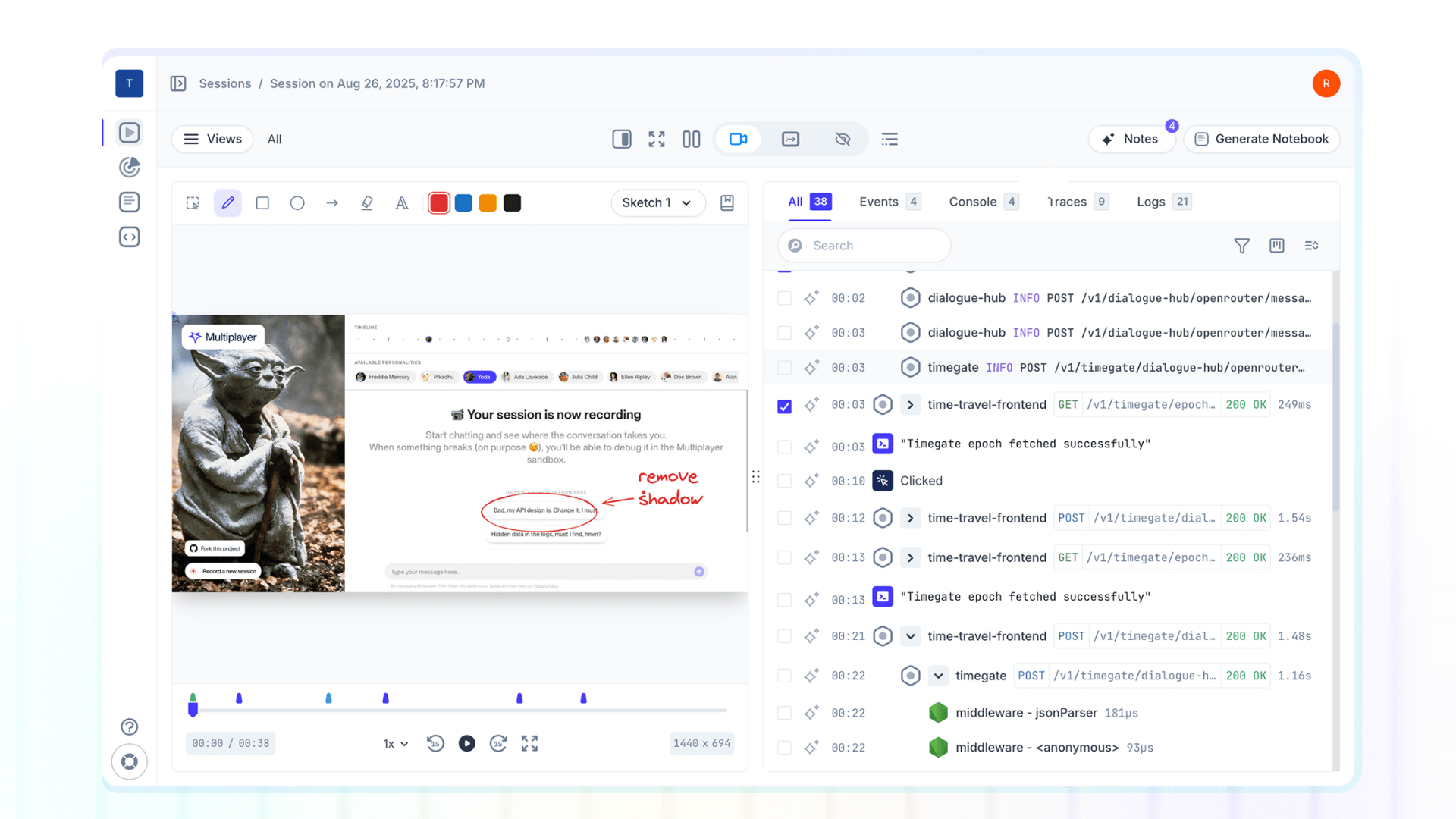
No more tool-hopping. No more sampled traces. No more "can you send me a screenshot?". The complete technical story exists, automatically captured and correlated, ready for your entire team to collaborate on. From the moment an issue occurs to the moment it's resolved.
Because software debugging was never meant to be a single-player game.
Run it locally, for free👇