How to win the AI dev-tools arms race
AI alone can't disrupt a business, the companies that survive and thrive are the ones that are using the technology to solve real problems.

We started talking about an "AI arms race" in 2023 when the numbers became impossible to ignore: OpenAI's ChatGPT gained 100 million users two months after launch, more than 1,000 mentions of AI appeared on S&P 500 company earnings calls, and Nvidia briefly reached a $1 trillion market capitalization.
This arms race continues unabated. Amid a broader investment drought, AI-related startups in the US have attracted the most funding since 2023. In 2025, AI startups attracted $89.4 billion in global venture capital, with industry analysts projecting continued robust investment through 2026.
Investors are sending a clear message: emphasizing your AI capabilities makes financial sense, and you don't want to be caught on the sidelines.
Yet end-users are already disillusioned with companies that rushed to release "innovative AI features" that are merely thin GPT wrappers, or that simply slapped "AI" labels over legacy products without meaningful improvement.

Should you add "AI" to your feature-set?
It's hard to argue that AI isn't a bubble waiting to pop when you hear gasp-inducing announcements like Inflection AI raising $1.3 billion, or Mistral AI, at just four weeks old raising approximately $113 million in a record-breaking EU seed round.
However, this kind of hype cycle and frenzied investing is inevitable when you develop paradigm-shifting technologies with the potential to touch every industry and enable genuinely new use cases.
Given the opportunity that AI and LLMs present, seeing substantial capital flow into the space is justified. But it's also reminiscent of the dot-com boom, where large sums were thrown at problems that existed only as business plans or fragments of code.
We'll inevitably see a spike in investments followed by the realization that not everything requires an AI solution (if we haven't already). Some investors will regret backing companies chasing problems that don't exist, while the companies that survive and thrive will be those using the technology to solve real problems.
How to win the AI products arms race
There have always been, and will continue to be, constant shifts in technology. It's natural to experience FOMO and want to adopt the newest releases. However, the key to winning the "AI Arms Race" (and arguably, any GTM race) is solving an existing, concrete, and proven problem.
AI alone can't disrupt a business. The graveyard of AI-based products that failed to find product-market fit is vast, with highly visible examples:
- Meta roughly lost $49B on its Reality Labs division since 2012
- Amazon lost ~$10B on Alexa
- Google shut down Duplex
- Ford is shut down Argo AI with at least a $827M loss
Finding product-market fit means offering a unique product that people desperately want because it solves a painful problem.
Moreover, enterprises can't simply "buy a technology," even one based on groundbreaking AI applications. You still need to invest time addressing control, security, versioning, management, and client privilege before it becomes a complete product or tool.
Why Multiplayer bets on "debugging"
It's a great time to be building with AI, but an even better time to solve the real-world challenges of debugging distributed systems.
Even the most talented and experienced developers face significant challenges when debugging modern systems:
- Complexity of modern architectures: Today's applications span multiple services, containers, databases, APIs, and third-party integrations. Tracing an issue across this landscape requires understanding how dozens of components interact, often with incomplete visibility into the full stack. No single developer typically has deep expertise across all layers, making cross-stack and cross-team debugging particularly challenging.
- Volume of data to analyze: Modern APM tools excel at providing graphs, log messages, traces, and metrics. However, developers still must manually sift through massive amounts of data, knowing where to look, what to monitor, and how to correlate signals across different tools to find the root cause.
- Reproducing issues: The hardest bugs to fix are those you can't reproduce. When an issue occurs only in production, with real user data and traffic patterns, engineers are left reconstructing what happened from incomplete logs and metrics.
- Context switching between tools: Debugging typically requires jumping between multiple tools. Logs in one place, metrics in another, session replays elsewhere, and code repositories in yet another location. This fragmentation slows investigation and makes it easy to miss critical context.
- Time pressure and customer impact: When users report issues or support teams escalate problems, engineers face pressure to diagnose and fix quickly. The longer it takes to understand what went wrong, the more customer trust erodes.
For AI tools to help developers address these challenges, they require the right data: full stack and contextual to the specific bug. This is harder to achieve than it seems because current tools provide only portions of this data. Session replay tools capture frontend user actions, APM tools provide sampled traces and logs, and developers must manually add additional context like feature requirements and system design notes.
Multiplayer's answer is full stack session recordings that automatically correlate end-to-end data per session: from frontend user actions to backend traces, logs, and request/response content and headers. Session can be fed to your IDE or AI coding tool of choice through a VS Code extension or MCP server.
How Multiplayer approaches AI
Today's software isn't a monolith; it's a mesh of microservices, APIs, and external dependencies. Understanding how things connect is as important as what any single component does.
After more than two decades as a backend developer, I've seen how fragmented the developer experience has become. When something breaks, developers are forced to jump between session replay tools, APM dashboards, and log aggregators. None of which tell the whole story.
Multiplayer automatically captures that bigger picture through full-stack session recordings that combine frontend actions, backend traces, logs, and request/response content in one replay. All correlated, enriched, and ready to feed into your AI tools.
This sits at the intersection of three converging trends:
- The rise of complex, distributed systems
- The shift toward AI-assisted development
- The demand for developer tools that minimize context switching and maximize clarity
By combining real-time, per-session observability with AI-ready data, Multiplayer helps developers move from guessing what went wrong to knowing how to fix it.
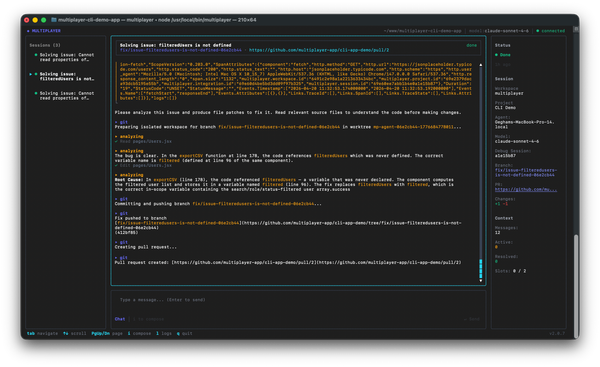
One copy/paste in your terminal and the debugging agent is running:
npm install -g @multiplayer-app/cli && multiplayer
Rather explore first?👇