Remote work and the developer experience
Recently, there has been an outpouring of commentary from CEOs in tech on the need to return to the office. We did a deep dive into how beneficial (or not) this would be for the productivity of developer teams.


The return-to-office debate that dominated 2023 has evolved into something more nuanced in 2025. While headlines spotlight major corporations like Amazon, Dell, and Walmart mandating five-day office returns, the data tells a more complex story: hybrid work has become the dominant model, with 24% of new job postings offering hybrid arrangements compared to just 12% fully remote.
The conversation has shifted from "remote vs. in-office" to "how do we make distributed work actually work?". For engineering teams, this question is particularly urgent because nearly half of hybrid and remote workers said they would be unlikely to stay in their job if their employer called them back to offices full-time.
More importantly, the rigid RTO mandates some companies have implemented aren't achieving their intended goals. Research shows that companies with strict RTO policies experienced 13% higher turnover and were twice as likely to report increased attrition. When over 500 AWS employees sent a letter to their CEO describing how "appalled" they were by the "non-data-driven explanation" for imposing a five-day in-office mandate, it highlighted a fundamental disconnect: many RTO policies are trying to solve complex organizational problems with a simple location-based answer.
What actually affects developer productivity?
Measuring the productivity of knowledge workers like engineers remains challenging. Developers engage in complex and creative tasks beyond writing code: mentoring, reviewing code, designing systems and features, managing releases, and debugging production issues.
Pounds of coal shoveled per hour will tell you which shovelers are the best shovelers; lines of code per minute will not tell you which software developers are the best software developers.
- A Human-Centered Approach to Developer Productivity
The Developer Experience (DevEx) framework helps us understand productivity through the lens of friction points developers encounter daily. Research identifies up to 25 sociotechnical factors affecting productivity, grouped into three critical areas: feedback loops, cognitive load, and flow state. These factors directly impact business performance through increased efficiency, product quality, and employee retention.
Recent data reveals that the key differentiator between underperforming and overachieving teams is aligning engineering resources to business priorities: especially crucial now as teams face pressure to do more with fewer resources.
Weaving these findings together reveals one persistent theme: the need for purposeful and consistent effort to build effective communication and implement thoughtful technology practices.
Notably absent from the top productivity factors? Working in the same office.
The real impact of distributed work on engineering teams
Working in person does offer distinct benefits. Cross-team collaboration can suffer in remote environments, as people working through screens may generate fewer creative ideas, and new hire onboarding requires more deliberate effort without experienced colleagues physically present.
However, these challenges are solvable. The key distinction, as remote work advocates have emphasized, is that pandemic-era emergency remote work *differs fundamentally* from intentionally designed distributed work practices.
For engineering teams specifically, distributed work creates unique challenges in debugging and supporting complex systems:
- Context fragmentation becomes exponentially worse: When debugging a distributed system issue, remote teams typically need to access multiple tools: support help desks, session replay tools, APM dashboards, error management platforms, Slack conversations, GitHub issues, and Jira tickets. One team we spoke with reported using up to ten different tools just to fully understand a single production issue.
- Knowledge silos amplify in distributed environments: When a senior developer who understands a legacy system works remotely, their tacit knowledge becomes even harder to transfer. Junior engineers can't easily look over their shoulder or observe their debugging process. The "tribal knowledge" that accumulates within teams becomes more opaque to newcomers without organic in-person knowledge sharing.
- Reproducing issues gets harder across time zones: The hardest bugs to fix are those you can't reproduce. When an issue occurs in production and the engineer investigating it is in a different time zone from the support team who saw it first, critical context gets lost in handoffs. Without tools that capture the complete picture, teams end up playing telephone across continents.
- Async collaboration requires better artifacts: Remote-first teams rely heavily on asynchronous communication. But when the artifacts you're working from are incomplete (partial logs here, a session replay there, some metrics in another dashboard) async debugging becomes a frustrating exercise in reconstruction rather than problem-solving.
These aren't arguments against distributed work, but in favor of better tooling that addresses the specific challenges distributed engineering teams face.
How modern tooling solves distributed debugging challenges
The solution isn't forcing everyone back to an office. It's recognizing that distributed teams need tools designed for how they actually work.
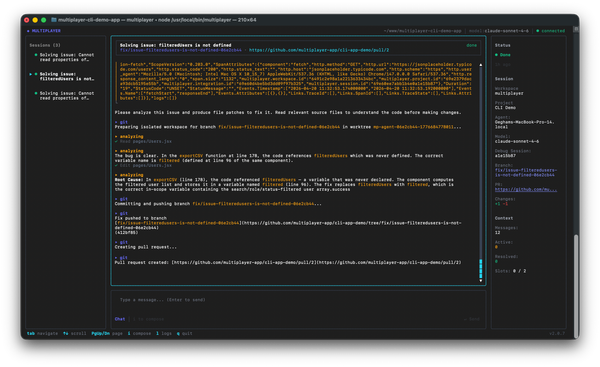
- Full stack session recordings address the context fragmentation problem: Instead of jumping between ten tools to understand a bug, teams need comprehensive session recordings that capture the complete story: frontend user interactions, console errors, backend traces, logs, request/response content and headers—all correlated by session.
- Automated system visibility reduces dependency on tribal knowledge: Distributed teams can't rely on the one person who "knows how everything works" being available in the office. Automated system dashboards that continuously reflect the current architecture (derived from actual telemetry data rather than manually maintained diagrams) give every team member accurate visibility into how services connect and communicate, regardless of their location or experience level.
- AI-assisted debugging: The quality of AI suggestions depends entirely on the quality and completeness of data available, which is why full-stack, session-based observability is crucial.
These tools don't replace the benefits of in-person collaboration. But they make distributed work sustainable and effective, particularly for the complex debugging workflows that modern engineering teams face daily.
Remote vs. Distributed
While much of this article discusses "remote" teams, it's important to recognize that the communication and debugging challenges we've outlined affect any distributed team, regardless of whether they're officially remote or not.
If your company has offices in multiple cities, you're managing a distributed team. If your backend engineers sit in New York while your frontend team is in San Francisco, you're distributed. If a single developer works from home two days a week while the rest of the team is in the office, you face distributed work challenges on those days.
The moment any part of your team isn't physically co-located with the people they need to collaborate with, you encounter the same fundamental issues: asynchronous communication becomes necessary, context gets lost in handoffs across time zones, debugging requires sharing complete artifacts rather than gathering around a monitor, and tribal knowledge becomes harder to transfer without organic in-person interactions.
Even companies with strict return-to-office policies rarely have every team member in the same physical space at the same time. Engineering teams collaborate with product managers in different buildings, consult with customer support teams in other offices, or coordinate with international colleagues during off-hours calls.
The real question isn't "should we be remote or in-office?".
It's "do we have the tools and processes to support effective distributed work when it inevitably occurs?".
Because for most engineering organizations, it's not a matter of if distributed collaboration happens, it's acknowledging that it already does, and equipping teams accordingly.
Developers are humans who value flexibility
Happy engineers build better code. Companies that create optimal working environments for developers tend to see stronger business outcomes, not just in revenue growth, but in innovation, customer satisfaction, and brand perception.
But engineers are also humans, and their job satisfaction is affected by the same fundamental factors that make life easier or harder for everyone. Competitive pay matters. Having a good manager matters. Feeling like your work contributes something meaningful matters. And increasingly, the ability to choose where and how you work matters too.
The preference for flexibility isn't just about avoiding commutes, though that's certainly part of it. It's about the accumulated costs and stresses of office work: the expense of commuting, the complexity of coordinating childcare, the challenge of relocating in expensive housing markets, and the constant interruptions that fragment deep work.
For many developers, remote or hybrid work has become a non-negotiable part of their employment expectations. Some would accept lower compensation to maintain flexibility. Others would leave otherwise good positions if forced to return to an office full-time. The willingness to trade other benefits for location flexibility signals how deeply workers value this autonomy.
This preference didn't emerge suddenly during the pandemic: it had been growing steadily for years before. Remote work's popularity was already rising as technology made it increasingly viable and as workers experienced its benefits firsthand.
The disconnect between what business leaders mandate and what employees prefer is real and measurable.
Ultimately, people are most productive and satisfied when working in whatever framework makes them feel fulfilled. There are many effective combinations of in-person and remote work, each suited to different individuals, teams, and use cases. Imposing a single rigid framework on diverse teams and people inevitably leads to friction, resentment, and attrition.
It's not remote work, it's the support systems around it
Leaders today are more focused than ever on optimizing team efficiency and effectiveness. But the data suggests that location isn't the primary variable affecting engineering productivity.
Instead, the key differentiators are:
- Trust and autonomy: Do leaders trust their teams to deliver results regardless of location?
- Communication infrastructure: Do teams have tools that enable effective async collaboration?
- Observability and debugging tools: Can engineers diagnose and fix issues without physically gathering in the same room?
- Knowledge management: Are insights and expertise captured in searchable, accessible formats rather than locked in individual heads?
Organizations that evolve their approach to workplace culture and invest in proper tooling (particularly for the complex debugging workflows that distributed engineering teams face) can reap the rewards of a diverse, global talent pool.
The companies thriving in 2025 are the ones that recognized distributed work is here to stay and invested in making it work effectively. For engineering teams, that means tools like full stack session recordings that provide the complete context needed to debug complex systems, regardless of where team members are located.
Run it locally, for free👇