AI will transform how we debug distributed systems
Even the most talented and experienced developers come across several challenges when debugging a large distributed system. AI can help with that.

I first become passionate about neural networks after reading David E. Rumelhart and James L. Mcclelland’s book “Parallel Distributed Processing.” I was obsessed with the idea that you can get computers to learn to do interesting things, not just perform pre-programmed tasks. However, computing power, memory, and storage weren’t really sufficient to solve many interesting problems in the late ‘80s.
Over the next several years I dove into designing, building, and managing large distributed systems but I couldn’t stay away from trying to find uses for neural nets. In fact, I even co-authored the paper "Radial Basis Functions for Process Control", where we explored using Gaussian mixture models rather than the sigmoidal activation functions in neural networks.
Skip ahead a few years and we finally have all the pieces in place for AI to revolutionize how we work in software development. In particular, through the lens of my experience, I can clearly draw a line between the latest technological advances in AI and how we will evolve in debugging and managing distributed systems.
AI is a powerful tool
As with any major technological advancement in history, change is scary and it can be met with fear and doubt. From the 2023 open letter to "Pause Giant AI Experiments" (edit: and the even more popular 2025 open letter to "We call for a prohibition on the development of superintelligence"), to statements that equate AI to the same threat levels presented by “pandemics and nuclear war”
The truth is that AI is a very powerful tool, and as with any tool, it can be used for good or bad purposes. While I do believe that it's important to raise awareness of the near-term potential dangers due to bias, discrimination, hallucinations, disinformation, deep fakes, etc., I have several points of skepticism around the likelihood of the creation of a non-aligned hyper-intelligent computerized agent that will pose an existential threat to humankind.
I'm mostly excited and hopeful about these advancements in AI: beyond it being an accelerator for scientific discovery, it's a tool that we can use in our everyday life to make us more productive and creative.
AI tools are making us (somewhat) better developers
It's clear that AI will continue to radically change software engineering, but it's an evolution, not an extinction. This distinction is particularly evident to software developers who have spent years building complex systems and understand the breadth of skills required. Skills that extend far beyond writing code, which what most AI coding excel at. The primary function of a software developer is using tools to creatively solve problems, not simply churn out code.
Software development is a profession that intrinsically demands continuous adaptation due to the relentless pace of innovation. The best developers I've known are highly adaptable individuals who approach every new change or challenge with curiosity and pragmatism. This explains why many developers are enthusiastically experimenting with AI in their daily workflows, much as they've already integrated ML-powered approaches and automation (from security checks to CI/CD pipelines) over the past several years.
Now, a few solid years into the AI coding assistant era, we can draw meaningful conclusions about their impact. These tools lower the barrier to entry for beginners and make experts more productive by automating tedious tasks. Recent MIT research found that tools like ChatGPT and Copilot are widely adopted, with over 80 percent of organizations having explored or piloted them, and nearly 40 percent reporting deployment.
However, that same research identifies a critical barrier to scaling AI adoption: "Most GenAI systems do not retain feedback, adapt to context, or improve over time." Indeed, most AI tools struggle with software development tasks requiring significant creativity and context: debugging, system design, and feature development. A 2025 survey by Harness found that roughly two-thirds of developers spend more time debugging AI-generated code or resolving AI-related security vulnerabilities than they save.
The core issue is context. Most AI tools still lack access to the comprehensive data and situational awareness that engineers must gather to make accurate decisions. Ultimately, the usefulness of AI tools depends heavily on two factors: the quality and completeness of data they can access, and the specific task they're performing.
How AI will transform debugging distributed systems
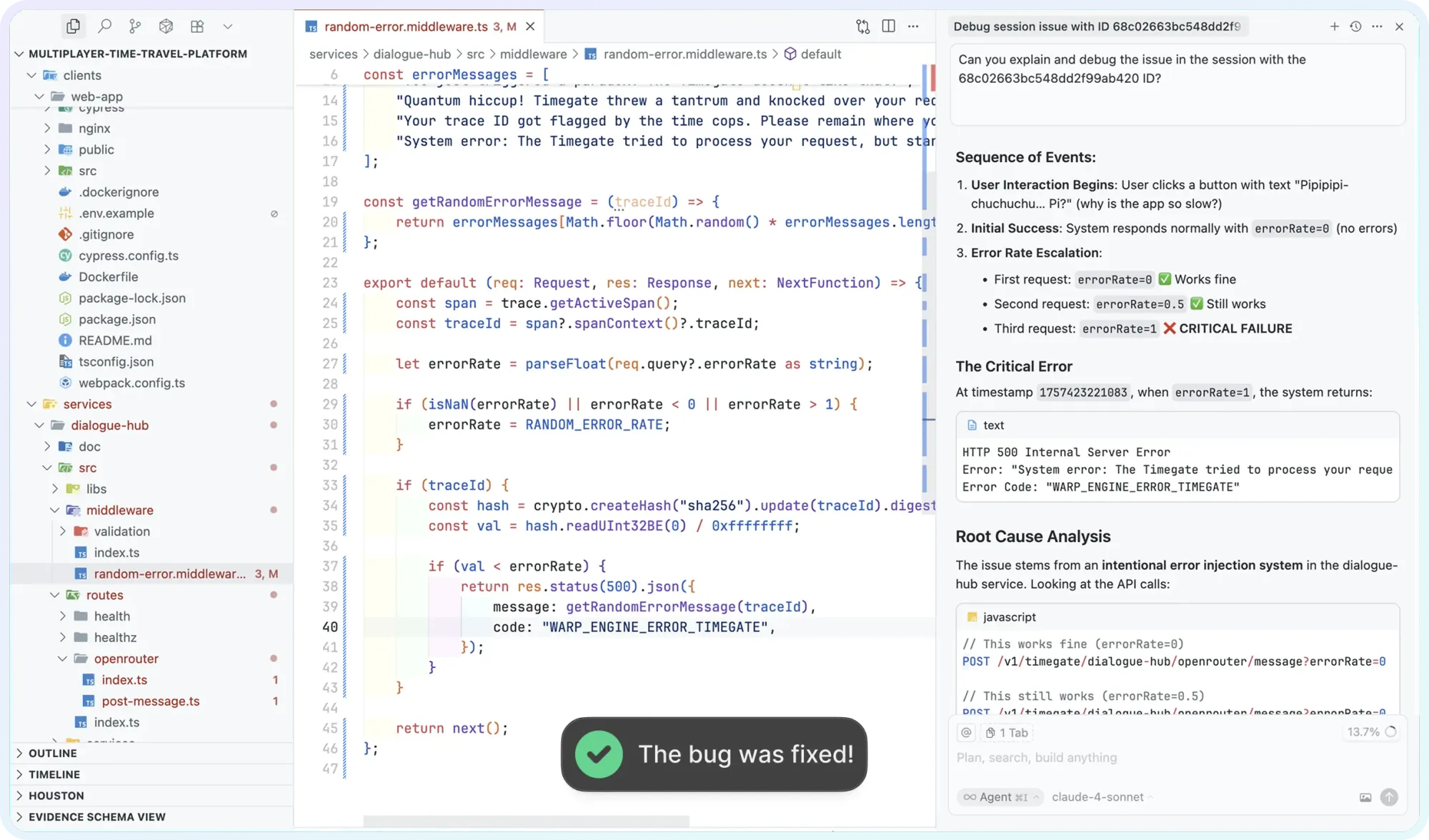
The key to making AI coding assistants genuinely useful for debugging lies in providing them with the context they've been missing. When AI tools have access to comprehensive, correlated data about what actually happened in your system, they can generate dramatically more accurate root cause analysis and fix suggestions.
The solution Multiplayer proposes is full stack session recordings: session replays that correlate end-to-end data per session, from user actions and console errors on the frontend, to backend traces, logs, request and response content and headers, all the way to team sketches and notes. This session-based approach captures the complete narrative of what happened, not just scattered data points across disconnected tools.
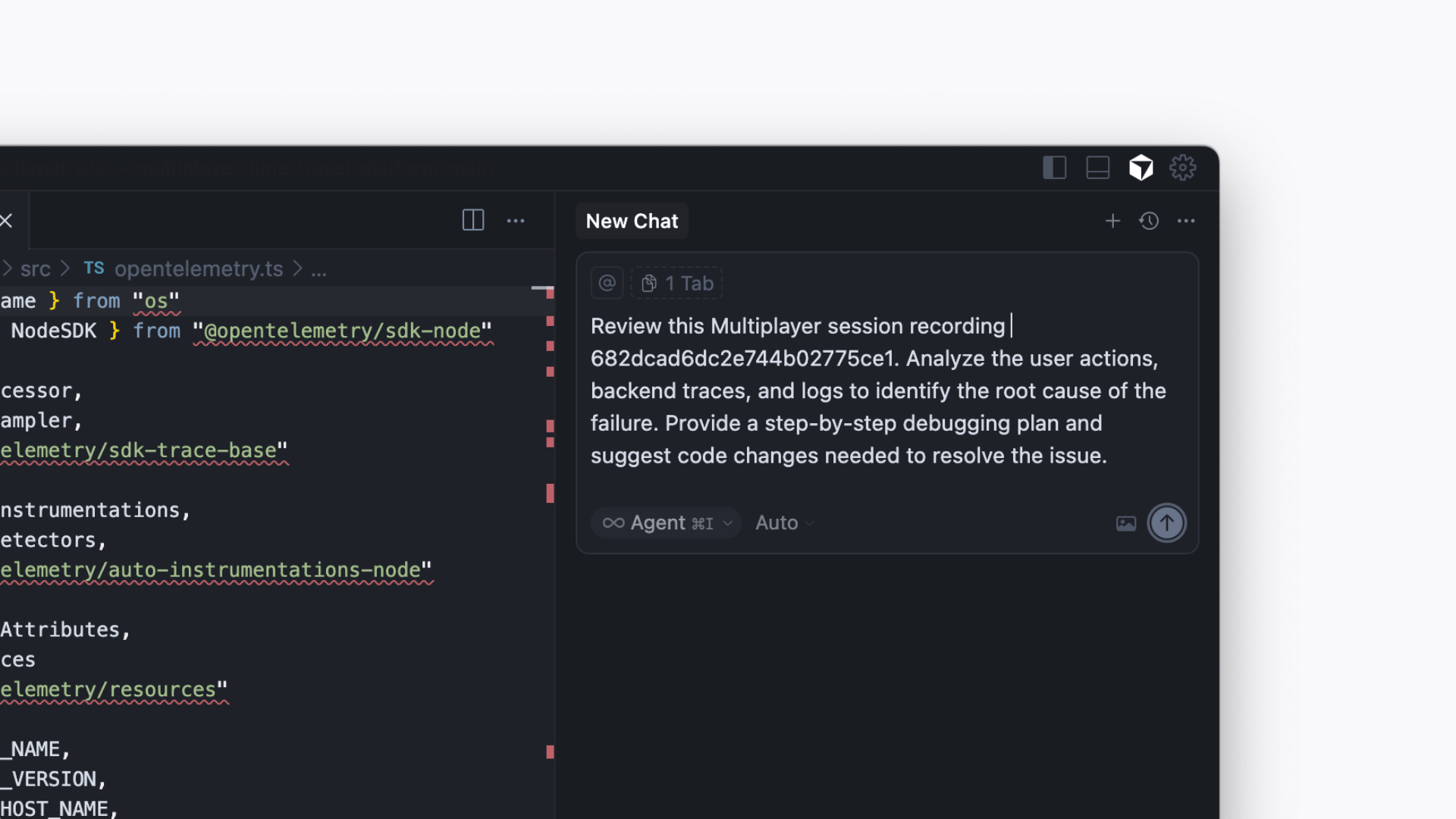
The combination of session-based, full stack observability and AI-powered analysis gives you the exact data you need to understand and act on specific technical issues and bugs. Here's how this transforms the debugging experience:
- AI-powered root cause analysis with full context: Instead of manually correlating logs, traces, and metrics across multiple tools, AI can analyze the complete context of a session through the full stack recording, identifying the root cause. Ask "Why did this checkout fail?" and get an answer that synthesizes the full story, not just fragments from individual monitoring tools.
- Code-level fix suggestions grounded in real behavior: When AI identifies the likely source of a bug, it can suggest specific fixes based on the actual error patterns observed in session data. The suggestions are grounded in real user interactions, not hypothetical scenarios.
- Pattern detection across sessions and incidents: With access to complete session data, AI can identify that your current issue matches patterns from previous incidents. Not just similar error messages, but similar sequences of user actions, API calls, and system states. It suggests solutions that worked before or flags when an issue exhibits a novel pattern requiring deeper investigation.
- Context-aware summaries for every stakeholder: AI generates summaries tailored to the audience, drawing from the rich context available in session recordings. Support teams get clear reproduction steps with actual user actions. Engineers get technical deep-dives with stack traces and query performance. Product managers get impact analysis with affected user segments and feature areas.
The future of debugging
There are many more applications for AI in the context of debugging distributed systems, and the key will be how well they resolve the real-world pain points developers and support engineering teams experience today. The combination of comprehensive session recording, full stack observability, and AI-powered analysis represents a fundamental shift in how we approach debugging.
The future is about giving developers superpowers to understand and fix complex systems faster than ever before. Just as AI assistants are already making us write better code, AI-powered debugging tools will make us dramatically more effective at maintaining and improving the systems we build.
Run it locally, for free👇